Introduction
What if you could blend the drapey elegance of knitting with the bold texture of crochet—into a single, stunning piece? It’s not only possible—it’s a secret weapon many fiber artists use to create uniquely expressive garments, accessories, and home décor.
For years, knitting and crochet have lived in separate lanes: knitters praising stitch definition and flow, crocheters celebrating speed and structure. But the truth is, these crafts aren’t rivals—they’re complementary languages of yarn. And when you learn to speak both, your creative vocabulary expands exponentially.
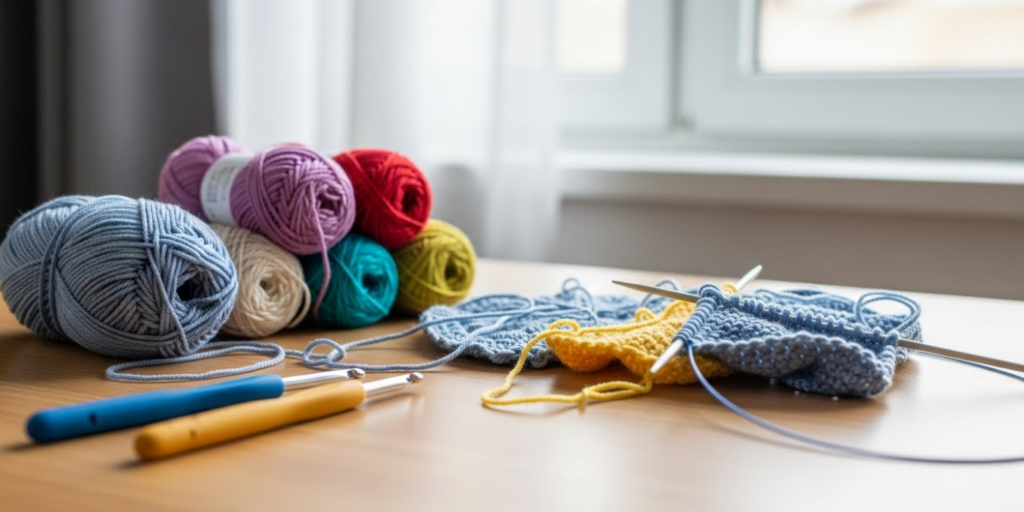
In this guide, you’ll discover how to thoughtfully combine knitting and crochet in one project—not as a gimmick, but as a deliberate design choice. We’ll explore why this hybrid approach works, how to plan seamless transitions, which techniques pair best together, and real-world examples to inspire your next make. Whether you’re a knitter curious about crochet edging or a crocheter dreaming of a garter-stitch yoke, you’ll walk away with practical strategies to merge these worlds with confidence. Ready to break the “rules” and stitch outside the lines? Let’s begin.
Why Combine Knitting and Crochet? The Best of Both Worlds
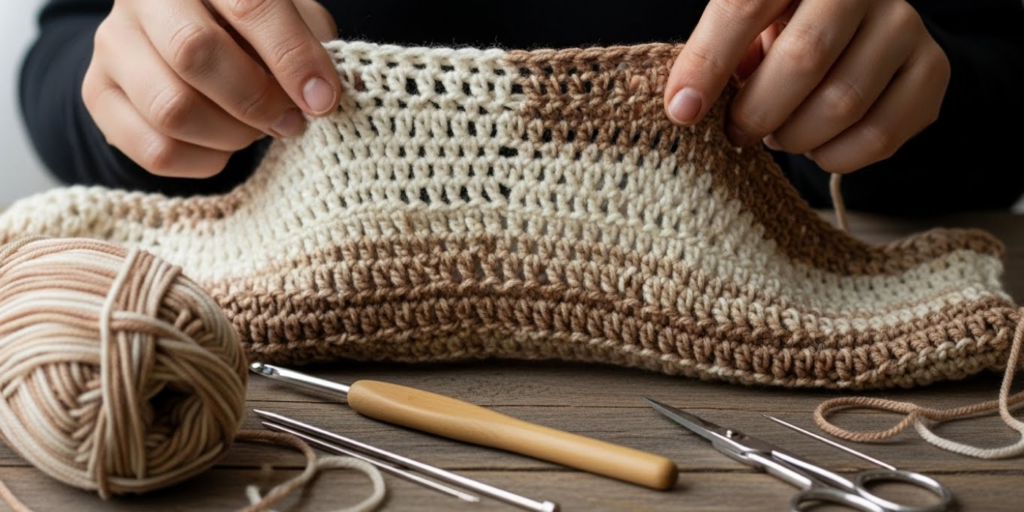
At first glance, knitting and crochet seem like opposites. Knitting uses two needles and creates interconnected loops with a fluid, stretchy fabric. Crochet uses one hook and builds stitches with more structure and density. But that contrast is precisely what makes them powerful together.
Imagine a knit sweater body for its soft drape and comfort, finished with a crocheted lace collar for intricate detail and stability. Or a crocheted market bag with a knitted i-cord drawstring for smooth texture and strength. Each technique fills the other’s gaps.
Benefits of hybrid projects include:
- Enhanced texture and visual interest: Smooth knit stockinette next to bumpy popcorn stitches creates dynamic contrast.
- Functional improvements: Crochet edging can prevent knit fabrics from curling. Knit linings can soften stiff crochet garments.
- Creative freedom: No longer limited by one craft’s constraints, you can solve design problems with the best tool for the job.
- Yarn efficiency: Use leftover yarns creatively—knit the main piece in one weight, crochet accents in scraps.
Moreover, combining techniques lets you honor both sides of your craft identity. Many makers start with one and later fall in love with the other. Why choose? You don’t have to.
Planning Your Hybrid Project: Where and How to Merge
The key to success isn’t just how you combine techniques—it’s where and why.
Start by asking: What purpose does each technique serve?
- Is crochet adding structure (like a sturdy border)?
- Is knitting providing stretch (like a ribbed cuff)?
- Are you using one for speed (crochet) and the other for drape (knit)?
Common and effective combinations include:
- Knit body + crochet edging (e.g., shawls, blankets, garments)
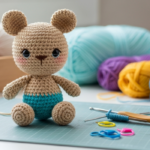
- Crochet base + knit appliqués (e.g., stuffed animals with knit faces)
- Knit sleeves + crochet yoke (common in vintage-inspired designs)
- Crochet handles + knit bag body (for strength and softness)
Important: Match gauge and drape where they meet.
A bulky, stiff crochet border on a delicate lace-knit shawl will pucker and pull. Swatch both fabrics side by side. If needed, adjust hook/needle sizes or stitch patterns to create harmony.
Pro Tip: Use a transition row. For example, when adding crochet to knit, work a row of single crochet into the knit edge using a slightly smaller hook to prevent flaring. This creates a clean, stable foundation.
Techniques for Seamlessly Joining Knit and Crochet
Now, let’s get technical—but in a friendly way! The goal is an invisible (or intentionally decorative) join that holds up to wear and washing.
1. Attaching Crochet to Knit Fabric
- Work into the purl bumps on the wrong side of stockinette, or into the ridge loops of garter stitch.
- Use a tapestry needle to mark your stitch count if needed—especially on curves or armholes.
- Keep tension even: Crochet tends to pull tighter than knitting. Loosen your grip slightly to avoid puckering.
2. Adding Knit Sections to Crochet
This is trickier but doable! One method:
- Leave a long tail when finishing your crochet piece.
- Use that tail (or a new strand) to cast on directly onto a knitting needle using the crochet chain as a foundation.
- Pick up stitches through the top loops of the crochet row, then knit as usual.
3. The “Hybrid Cast-On” Trick
Start with a crocheted foundation chain, then pick up knit stitches through the back bumps of the chain (like a provisional cast-on). This creates a flexible, integrated edge perfect for scarves or cowls.
4. Using i-Cord or Crochet Cords as Connectors
Need to join two separate pieces? A knitted i-cord or crocheted cord can act as a stylish, functional bridge—think drawstrings, straps, or decorative seams.
Always block your finished piece. Blocking relaxes tension differences and helps the fabrics settle into a unified whole.
Beginner-Friendly Project Ideas to Try Today
You don’t need an advanced degree in fiber arts to start hybrid crafting. Here are three accessible projects to build confidence:
1. Knit Scarf with Crochet Fringe
Knit a simple garter-stitch scarf, then add tassels or picot fringe using crochet. The fringe adds movement and weight without altering the scarf’s drape.
2. Crochet Blanket with Knit Border
Work a cozy granny square blanket, then pick up stitches along the edge and knit a few rows of ribbing or seed stitch. The knit border softens the look and keeps the blanket from rolling.
3. Knit Hat with Crochet Flower
Knit a basic beanie, then top it with a bullion-stitch rose or puff-stitch daisy. It’s a fun, fast way to personalize your make.
Bonus Idea: Make a dishcloth with a knit center for absorbency and a single crochet border for durability around the edges. Practical and pretty!
These projects teach you how the fabrics behave together—without overwhelming you. Start small, then dream bigger.
Troubleshooting Common Challenges (And How to Fix Them)
Even with the best plan, hybrid projects can throw curveballs. Here’s how to handle them:
Problem: The seam puckers or ripples.
→ Cause: Tension mismatch or too many/few stitches.
→ Fix: Adjust hook/needle size, or add/remove stitches gradually using increases/decreases over 2–3 rows.
Problem: The join feels stiff or bulky.
→ Cause: Using too thick a yarn or too dense a stitch.
→ Fix: Switch to a lighter-weight yarn for the transition row, or use slip stitch or single crochet instead of double.
Problem: The fabrics curl in opposite directions.
→ Cause: Stockinette knit curls one way; some crochet stitches curl another.
→ Fix: Add a stabilizing border (like garter stitch or mesh crochet) to both sides, or fully line the piece.
Problem: Washing causes distortion.
→ Always swatch and wash your test piece first! Natural fibers (wool, cotton) behave differently than acrylics. Match fiber content when possible.
Remember: imperfections often add character. A slightly wavy edge might look intentional in a boho-style shawl.
Inspiring Examples from the Fiber Community
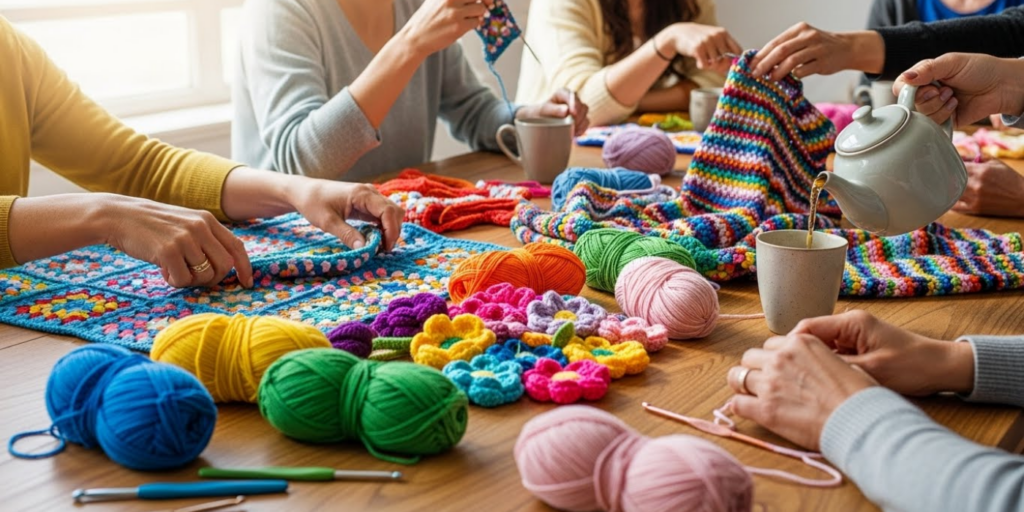
You’re not the first to walk this path—and the results are stunning.
- Designer Julia Farwell-Clay often blends knit bodies with crocheted lace yokes in her modern sweater designs, creating heirloom pieces with architectural flair.
- Elena Kanter (owner of Woolenberry) famously pairs garter-stitch knit blankets with intricate crocheted edgings, blending Scandinavian simplicity with Eastern European detail.
- On Instagram, #knooking (a technique using a special hooked needle) has sparked a mini-revolution—but even without special tools, makers worldwide share hybrid cardigans, baby booties, and market bags that marry both crafts beautifully.
These creators prove that rules are guidelines, not barriers. When technique serves vision, magic happens.
Embrace the Hybrid Mindset: Beyond the Stitches
Combining knitting and crochet isn’t just a technical skill—it’s a mindset. It’s about seeing possibilities instead of boundaries. It’s trusting your hands to speak more than one language. And it’s giving yourself permission to create something that doesn’t fit neatly into a category.
In a world that often asks us to “pick a lane,” hybrid crafting whispers: Why not both? Your scarf doesn’t care if its fringe was made with a hook or needles—it only knows it’s loved, worn, and uniquely yours.
So don’t wait for “permission.” Grab your favorite yarn, your trusty needles, and your go-to hook. Let curiosity lead. The most beautiful projects often live in the in-between.
Conclusion
Merging knitting and crochet in one project opens a world of texture, function, and creative expression. From planning intentional transitions to choosing complementary stitches and troubleshooting tension issues, you now have the tools to blend these crafts with confidence.
We’ve explored why combining them works, how to join fabrics seamlessly, beginner-friendly ideas to start with, and real inspiration from the maker community. The key takeaway? Let each technique do what it does best, and use their differences to create something greater than the sum of its parts.
Now it’s your turn. Pick a simple project—maybe that knit scarf begging for a crochet picot edge—and take the leap. You might just discover your new favorite way to make.
We’d love to see what you create! Have you tried a hybrid project before? What surprised you? Share your stories, photos, or questions in the comments below. And if this guide sparked an idea, pass it on to a fellow maker who’s ready to stitch (and hook!) outside the box. Happy creating!

Sophia Williams is a crochet enthusiast who found in yarn and hooks a creative way to express calm, patience, and love for handmade art. Focused on the crochet niche, she shares her experience, techniques, and inspiration with those who want to learn, relax, and create meaningful pieces stitch by stitch.