Introduction
Imagine this: you’ve just bought your first hooks or needles, watched a few YouTube tutorials, and you’re ready to make your first scarf. But then you walk into the yarn aisle—and freeze. Rows upon rows of colorful skeins, each labeled with mysterious symbols, fiber blends, and weights. Which one won’t split? Which one won’t tangle? Which one will actually show your stitches instead of hiding them in fluff?
Choosing the right yarn as a beginner isn’t just about color—it’s about setting yourself up for success. The wrong yarn can turn a fun hobby into a frustrating battle with slippery strands, invisible stitches, or yarn that frays after three rows. But the right yarn? It makes your stitches pop, glides smoothly through your fingers, and gives you the confidence to keep going.
In this guide, we’ll walk you through everything you need to know to pick the best beginner-friendly yarns for crochet and knitting. You’ll learn what fiber types work best, which yarn weights are easiest to handle, and exactly which brands consistently earn rave reviews from new crafters. Plus, we’ll share practical tips for reading yarn labels, avoiding common pitfalls, and even saving money while you learn. Whether you’re dreaming of a cozy blanket or a simple dishcloth, the right yarn is your secret weapon. Let’s find your perfect match.
Why Yarn Choice Matters More Than You Think
Many beginners assume “yarn is yarn”—but that couldn’t be further from the truth. The material, texture, and thickness of your yarn directly affect how easy it is to see your stitches, maintain even tension, and correct mistakes.
For example, eyelash yarn might look fun, but its fuzzy texture hides every stitch, making it impossible to count or fix errors. Silk or bamboo can be slippery, causing stitches to slide off needles or hooks unintentionally. And super-fine lace-weight yarn is so thin that dropped stitches vanish like ghosts.
On the flip side, a smooth, medium-weight acrylic shows every loop clearly, doesn’t split easily, and is forgiving when you need to frog (rip out) your work—which you will, and that’s okay!
Think of learning to drive: you wouldn’t start on a racecar. You’d choose a reliable, easy-to-handle sedan. Your first yarn should be your crafting “sedan”—predictable, affordable, and beginner-proof.
Moreover, a good yarn feels satisfying to work with. That tactile joy—smooth gliding, clear stitch definition, soft texture—fuels motivation. When your hands feel good, your mind stays engaged, and your skills grow faster.
Top Fiber Types for New Crocheters and Knitters
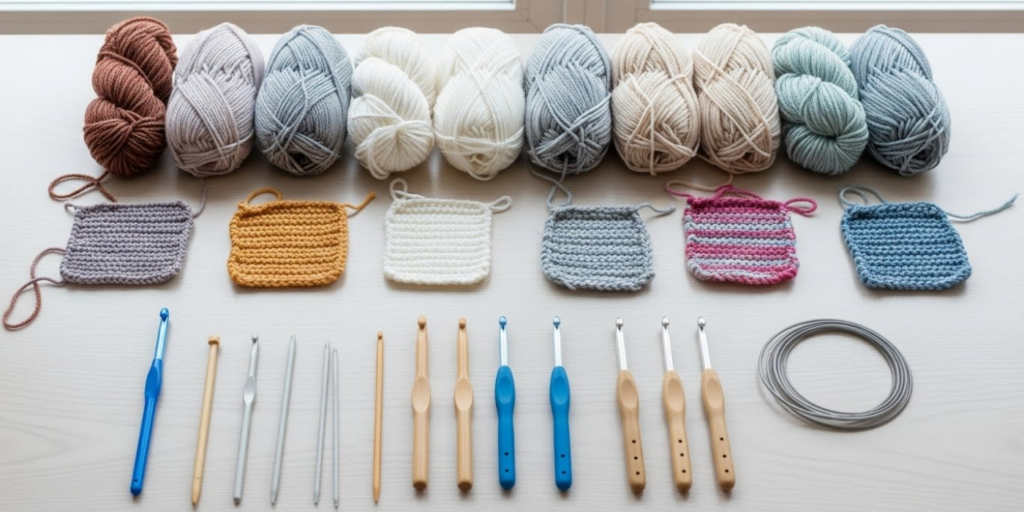
Not all fibers are created equal when you’re just starting out. Here’s a quick breakdown of the best—and worst—choices:
1. Acrylic (Best Overall for Beginners)
- Pros: Affordable, durable, machine-washable, widely available, and comes in every color imaginable.
- Cons: Less breathable than natural fibers, can pill over time.
- Why it’s great: Smooth, consistent texture makes stitch definition crystal clear. Brands like Red Heart Super Saver and Lion Brand Basic Stitch Anti-Pilling are staples for a reason.
2. Cotton (Excellent for Dishcloths, Summer Projects)
- Pros: Breathable, strong, stitch definition is sharp, great for amigurumi or home goods.
- Cons: Less elastic than wool—can feel stiff and doesn’t “bounce back” if you drop a stitch.
- Top pick: Lily Sugar’n Cream or Bernat Handicrafter Cotton—smooth, sturdy, and inexpensive.
3. Wool Blends (Great for Warmth and Elasticity)
- Pros: Naturally stretchy, warm, and forgiving. Mistakes are easier to fix because wool “grips” needles/hooks.
- Cons: Can be itchy (choose merino), often requires hand-washing, and pricier.
- Beginner-friendly option: Lion Brand Wool-Ease (80% acrylic, 20% wool)—soft, washable, and bouncy.
Avoid as a beginner:
- Mohair, angora, or eyelash yarns (too fuzzy—stitches disappear)
- Pure silk or rayon (too slippery)
- Novelty yarns (bobbles, loops, or metallic threads—hard to control)
Stick with smooth, matte-finish yarns in solid or subtly variegated colors. Save the sparkles and fluff for when you’ve mastered the basics!
Ideal Yarn Weight: Why Medium (Worsted) Wins
Yarn comes in weights from lace (0) to jumbo (7). For beginners, medium weight—also called “worsted” or “aran” (weight 4)—is the sweet spot.
Here’s why:
- Stitches are large enough to see clearly, but not so big that your project balloons in size.
- Works up quickly, giving you satisfying results faster.
- Compatible with common hook/needle sizes (5–5.5mm for crochet, US 7–9 for knitting), which are easy to hold.
Light worsted (DK, weight 3) is also a good choice if you want slightly finer detail—great for baby items or lightweight garments.
Avoid fingering (weight 1) or lace (weight 0) yarns at first—they’re frustratingly tiny. And while bulky (weight 5) and super bulky (weight 6) yarns work up fast, they can hide tension inconsistencies and make it harder to see individual stitches.
Pro tip: Look for the standard yarn weight symbol on the label—a number inside a skein icon. Stick to #4 for your first few projects.
Top 5 Beginner-Friendly Yarns (With Real-World Pros and Cons)
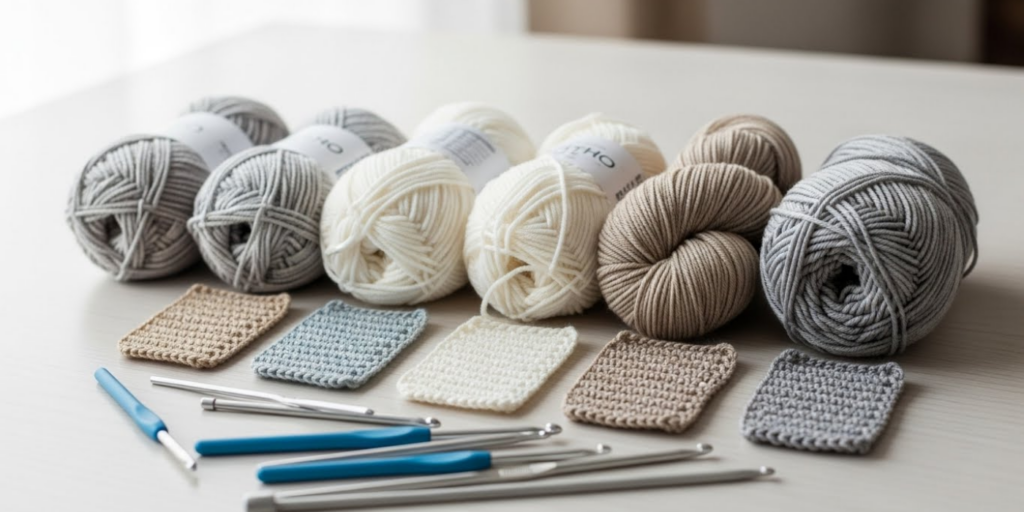
Let’s get specific. Here are five yarns that consistently top beginner lists—with honest insights:
1. Red Heart Super Saver (Worsted, Acrylic)
- Price: ~$3–4 per skein
- Why it’s great: Affordable, durable, and available everywhere (Walmart, Joann, Michaels). Comes in solids and prints.
- Downside: Can feel a bit stiff at first (softens with washing).
- Best for: Practice swatches, blankets, scarves.
2. Lion Brand Basic Stitch Anti-Pilling (Worsted, Acrylic)
- Price: ~$6 per skein
- Why it’s great: Softer than Super Saver, resists pilling, and has a lovely sheen.
- Downside: Slightly pricier, but worth it for wearable items.
- Best for: Hats, sweaters, gifts.
3. Lily Sugar’n Cream (Worsted, 100% Cotton)
- Price: ~$2–3 per skein
- Why it’s great: Stiff enough to hold shape, perfect for kitchen items or amigurumi.
- Downside: No stretch—be gentle with tension.
- Best for: Dishcloths, coasters, toys.
4. Bernat Super Value (Worsted, Acrylic)
- Price: ~$4 per skein
- Why it’s great: Consistent thickness, smooth, and comes in ombre prints that hide minor tension issues.
- Downside: Limited color range compared to Red Heart.
- Best for: Blankets, beginner garments.
5. Caron Simply Soft (Worsted, Acrylic)
- Price: ~$5 per skein
- Why it’s great: Silky soft with a beautiful drape—great for baby items.
- Downside: Slightly slippery; not ideal for learning tight tension.
- Best for: Baby blankets, shawls, lightweight projects.
Bonus tip: Buy one skein first before committing to a whole project. Test it with your hook/needles. Does it split? Is it too slippery? Trust your hands—they’ll tell you.
How to Read a Yarn Label Like a Pro
Yarn labels aren’t just for show—they’re packed with essential info. Here’s what to look for:
- Yarn weight number (0–7): Stick to 3 or 4.
- Fiber content: Avoid mystery blends with “other” as a main ingredient.
- Recommended hook/needle size: Start here, then adjust based on your tension.
- Gauge: Usually given as “16 sts = 4 inches.” Swatching to this gauge ensures your project turns out the right size.
- Care instructions: Machine-washable? Hand-wash only? Choose easy-care for early projects.
- Dye lot number: Always buy enough yarn from the same dye lot—shades can vary between batches!
Real-world example: You buy two skeins of “oatmeal” yarn, but one has dye lot #12 and the other #15. When you join them, there’s a visible stripe. Avoid this by checking labels before checkout.
Common Beginner Yarn Mistakes—and How to Avoid Them
Even with good intentions, new crafters often fall into a few traps:
Mistake #1: Choosing dark or variegated yarn
Black, navy, or rainbow yarns look cool—but they hide your stitches, making it hard to learn. Start with light solids like cream, gray, or blush.
Mistake #2: Buying the cheapest yarn possible
Ultra-budget yarns often have inconsistent thickness or split easily. Spend a little more for reliability—it saves frustration (and time) in the long run.
Mistake #3: Ignoring texture
Fluffy, fuzzy, or bumpy yarns feel fun but are terrible for learning. Stick to smooth, even strands.
Mistake #4: Not buying enough yarn
Running out mid-project is heartbreaking. Check the pattern’s yardage, then buy one extra skein as a safety margin.
Mistake #5: Skipping the swatch
A 4×4 inch swatch tells you if your tension matches the pattern—and whether you like working with the yarn. Don’t skip it!
Conclusion
Choosing the right yarn as a beginner isn’t about perfection—it’s about creating the best conditions for learning, enjoyment, and progress. By selecting smooth, medium-weight yarns in light, solid colors—like Red Heart Super Saver, Lion Brand Basic Stitch, or Lily Sugar’n Cream—you give yourself the gift of clarity, comfort, and confidence.
Remember: every expert crafter started exactly where you are. They made mistakes, frogged projects, and bought the wrong yarn too. But they kept going—because the joy of making something with your own hands is worth every tangled moment.
So head to your local craft store (or browse online) with this guide in hand. Pick one yarn that fits the criteria, grab the recommended hook or needles, and cast on. Your first stitch is the beginning of a beautiful, creative journey.
What was the first yarn you learned with? Did it help—or hinder—your progress? Share your story in the comments! And if this guide saved you from yarn confusion, pass it along to a friend who’s just starting to knit or crochet. Happy stitching!

Sophia Williams is a crochet enthusiast who found in yarn and hooks a creative way to express calm, patience, and love for handmade art. Focused on the crochet niche, she shares her experience, techniques, and inspiration with those who want to learn, relax, and create meaningful pieces stitch by stitch.