
Introduction
There’s something deeply comforting about wrapping yourself in a handmade blanket—especially when you made it yourself. The weight, the texture, the colors you chose with care… it’s more than a cozy cover; it’s a labor of love. And the best part? You don’t need years of experience to make one.
If you’ve just learned how to hold a hook or can barely tell a single crochet from a double, don’t worry. Some of the most beautiful blankets use only one or two basic stitches, repeated row after row. For beginners, a blanket isn’t just a functional project—it’s a confidence builder, a rhythm creator, and a canvas for your first creative voice in yarn.
In this guide, we’ll walk you through five easy, beginner-friendly blanket patterns that are simple to follow, forgiving of small mistakes, and stunning when finished. You’ll also learn how to choose the right yarn and hook, estimate how much yarn you’ll need, and avoid common pitfalls that trip up new crocheters. Whether you’re making a baby gift, a lapghan for your couch, or your very first full-sized throw, you’ve got this.
So grab your hook, unwind a skein of soft yarn, and let’s stitch your way to cozy success—one simple row at a time.
Why Blankets Are Ideal First Projects for New Crocheters
Many beginners assume blankets are too big or too hard—but they’re actually one of the best starting points for several reasons.
First, blankets are flat and rectangular, which means no shaping, seaming, or complex increases/decreases. You simply repeat the same stitch pattern row after row. This repetition builds muscle memory, helping you master tension and stitch consistency without overwhelming your brain.
Second, mistakes are easy to hide or fix. A skipped stitch or uneven edge won’t ruin the whole piece—especially in textured or variegated yarns. And if you need to frog (rip out) a row, you’re only losing minutes, not hours of intricate work.
Third, blankets offer immediate gratification through progress. Even if it takes weeks to finish, you can see (and feel!) your work growing. According to a 2022 survey by the Craft Yarn Council, beginners who started with blankets were 65% more likely to continue crocheting than those who began with amigurumi or garments.
Think of it like learning piano: You wouldn’t start with a symphony. You’d practice scales—simple, repetitive, foundational. A blanket is your crochet scale.
And unlike tiny projects that vanish into drawers, a finished blanket becomes a visible, usable reminder of your skill and patience. That’s powerful motivation.
Pattern #1: The Classic Single Crochet Blanket (Simple, Dense, and Cozy)
Skill level: Absolute beginner
Stitches used: Chain (ch), single crochet (sc)
Yarn: Medium weight (#4) acrylic or cotton blend (e.g., Red Heart Super Saver, Lion Brand Basic Stitch)
Hook: Size I/9 (5.5 mm)
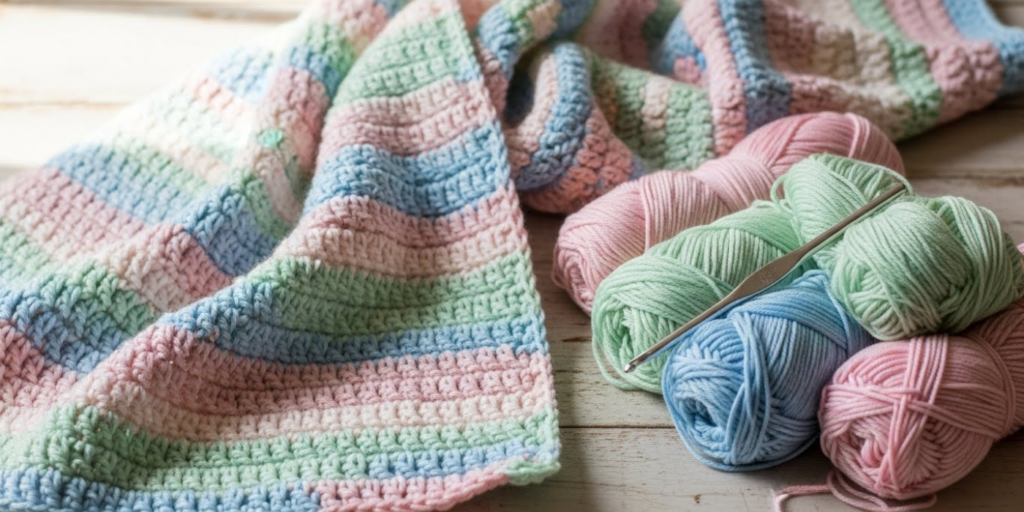
This is the gold standard of beginner blankets. The single crochet stitch creates a tight, warm fabric that’s perfect for babies, lapghans, or winter throws.
Basic instructions:
- Chain your desired width (e.g., 100 chains for a 30″ wide blanket).
- Row 1: Single crochet in the second chain from hook, and in each chain across.
- Row 2: Chain 1, turn, single crochet in each stitch across.
- Repeat Row 2 until your blanket reaches the desired length.
Pro tip: Add a border when finished—a round of single crochet along the edges cleans up any unevenness and gives it a polished look.
Why it works: You only need to count once (on the foundation chain). After that, it’s pure rhythm. Plus, the tight fabric hides any slight tension issues.
Yarn amount: For a 30″x40″ throw, plan for 1,200–1,500 yards (about 6–8 skeins of worsted weight yarn).
Pattern #2: The Granny Stripe Blanket (Colorful, Fast, and Forgiving)
Skill level: Beginner
Stitches used: Chain, double crochet (dc), slip stitch (sl st)
Yarn: Any worsted weight; great for using up scraps or trying bold color combos
Hook: Size J/10 (6.0 mm)
The granny stripe—a simplified version of the classic granny square—works up quickly and looks far more complex than it is. Each row is a series of 3-dc clusters separated by chain spaces.
Basic instructions:
- Chain a multiple of 3 + 2 (e.g., 92 chains for a 30″ width).
- Row 1: Dc in 5th chain from hook, skip 2 chains, 3 dc in next chain; repeat to end.
- Row 2: Chain 4 (counts as first dc + ch-1), turn, 3 dc in the space between clusters below, ch 1; repeat across.
- Continue, changing colors every 2–4 rows if desired.
Bonus: No turning gaps! The chain-1 spaces create a seamless, flowing stripe.
Why it’s beginner-friendly: The open fabric hides uneven edges, and color changes distract from minor stitch inconsistencies. Plus, it uses less yarn than solid stitches—great for budget crafters.
Real-life win: Emma, a new crocheter from Texas, made a rainbow granny stripe blanket for her newborn nephew in just three weeks—working 30 minutes a night. “It looked like I’d been crocheting for years,” she said.
Pattern #3: The Ripple (or Chevron) Blanket (Timeless Texture with Minimal Effort)
Skill level: Confident beginner
Stitches used: Double crochet, chain
Yarn: Worsted weight or bulky for faster results
Hook: Size J/10 (6.0 mm) or larger
The ripple blanket features gentle waves created by increases and decreases—but don’t let that scare you. The pattern is just a repeat of a few simple steps.
Basic repeat (for one “wave”):
- Increase: Work 2 dc in one stitch
- Decrease: Skip stitches or work dc together (dc2tog)
- Repeat across the row
Sample row:
Ch 122 (multiple of 12 + 2).
Row 1: Dc in 4th ch from hook, dc in next 3 ch, dc2tog over next 2 ch, ch 2, dc2tog, dc in next 3 ch, 3 dc in next ch; repeat across.
Design tip: Use two or three colors in blocks (e.g., 6 rows per color) to highlight the wave pattern without overwhelming the eye.
Why it’s worth trying: The texture adds visual interest without complicated stitches. And once you memorize the 6–8 stitch repeat, you can work while watching TV or chatting with friends.
Note: Count your stitches every few rows to stay aligned—ripples can drift if increases/decreases get off track.
Pattern #4: The Moss Stitch (aka Linen Stitch) Blanket (Modern, Woven Look)
Skill level: Beginner with some experience
Stitches used: Chain, single crochet, chain space
Yarn: Cotton or cotton-blend for drape (e.g., Lily Sugar ’n Cream, Lion Brand 24/7 Cotton)
Hook: Size H/8 (5.0 mm)
The moss stitch alternates single crochets and chain spaces in a staggered pattern, creating a fabric that looks like handwoven linen—dense, elegant, and subtly textured.
Basic instructions:
- Chain an odd number (e.g., 91).
- Row 1: Sc in 4th chain from hook, ch 1, skip 1 ch, sc in next ch; repeat to end.
- Row 2: Ch 3 (counts as ch-1 + sc), ch 1, sc in next ch-1 space; repeat across.
- Repeat Row 2 for the entire blanket.
Key insight: You’re always working into the chain spaces, not the sc stitches. This creates the staggered effect.
Why it’s special: This stitch doesn’t curl, lies flat naturally, and feels luxurious against the skin—ideal for lightweight throws or summer blankets.
Yarn tip: Use a solid or tonal color to let the texture shine. Variegated yarns can obscure the pattern.
Pattern #5: The “Just One Stitch” Blanket (Your Custom Starter Project)
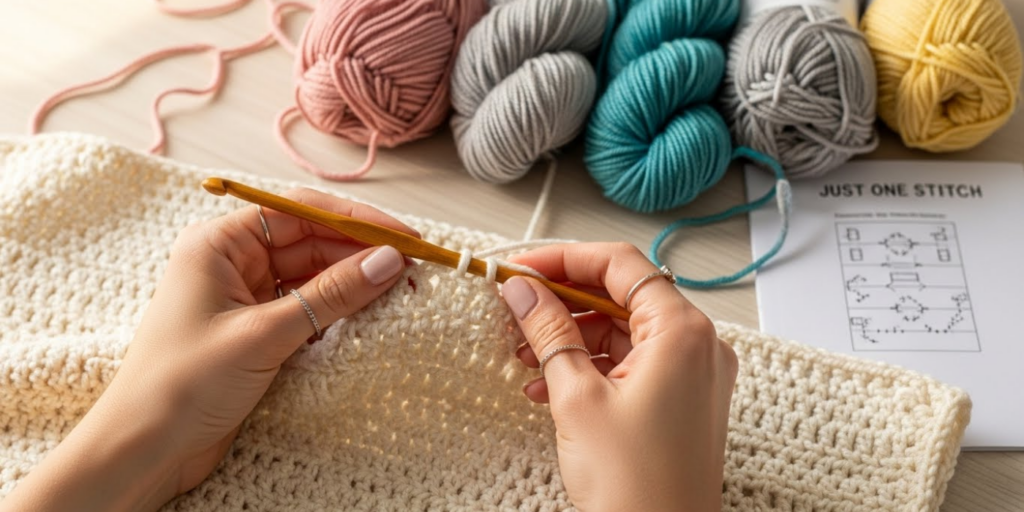
Not ready to follow a full pattern? Try the “One Stitch Challenge”:
- Choose any basic stitch you know: single crochet, double crochet, half-double, or even the granny stripe cluster.
- Pick one yarn (or a few coordinating colors).
- Decide on a size (baby = 30″x30″, throw = 50″x60″).
- Chain your width, then repeat your stitch across every row until you reach your length.
That’s it. No counting beyond the first row. No complex charts.
Why this works: Perfection isn’t the goal—completion is. Many beginners get stuck trying to find the “perfect” pattern. Sometimes, the best pattern is the one you actually finish.
This approach builds creative confidence. Once you’ve made one, you’ll know your tension, your pace, and your preferences—and you’ll be ready for more.
Tips for Blanket Success: Yarn, Tools, and Mindset
To make your blanket journey smooth, keep these tips in mind:
- Choose forgiving yarn: Avoid dark, fuzzy, or slippery yarns at first. Light-colored, smooth, worsted-weight acrylic is easiest to see and work with.
- Use stitch markers: Place one at the start of each row to help you count and stay even.
- Measure as you go: Every 10 rows, lay your blanket flat and measure. This helps you estimate finishing time and yarn needs.
- Embrace imperfection: Your first blanket doesn’t need to be flawless. It needs to be yours.
- Take breaks: Crocheting for hours can strain wrists. Try the “20-20-20 rule”: Every 20 minutes, rest your hands for 20 seconds and stretch.
Remember: Every expert crocheter started with a wobbly, slightly crooked blanket. Yours is your badge of courage.
Final Thoughts: Your First Blanket Is More Than Fabric
That pile of yarn on your lap? It’s becoming more than a blanket. It’s proof that you showed up, practiced, and created something beautiful with your hands. In a world of instant everything, there’s profound power in slow, mindful making.
And when you tuck someone in with a blanket you stitched row by row, you’re wrapping them in patience, care, and quiet love.
Conclusion
Starting your crochet journey with an easy blanket pattern is one of the smartest—and most rewarding—choices you can make. From the sturdy single crochet to the playful granny stripe and the elegant moss stitch, these beginner-friendly designs offer simplicity without sacrificing beauty. You’ve learned how to choose yarn, estimate size, avoid common mistakes, and even create your own “one-stitch” project.
Now, the only thing left to do is begin. Pick a pattern that speaks to you, gather your supplies, and trust that every stitch brings you closer to something warm, wonderful, and entirely your own.
We’d love to cheer you on! Which blanket pattern will you try first? Have you already finished one? Share your progress, ask questions, or post photos in the comments below—we’re all learning together. And if this guide helped you take the leap, please share it with a friend who’s been curious about crochet. After all, the world could always use more handmade warmth.
Sophia Williams is a crochet enthusiast who found in yarn and hooks a creative way to express calm, patience, and love for handmade art. Focused on the crochet niche, she shares her experience, techniques, and inspiration with those who want to learn, relax, and create meaningful pieces stitch by stitch.