
Introduction
You’ve poured your heart into designing adorable amigurumi, stitching cozy blankets, and photographing your creations with care—but your crochet sales aren’t growing the way you hoped. Sound familiar? Here’s the good news: the answer might not be to crochet more, but to understand your customers better. And that’s where analytics comes in.
Analytics isn’t just for tech companies or big retailers. Even as a small handmade seller on Etsy, Shopify, or Instagram, you have access to powerful data that can reveal what’s working, what’s not, and exactly how to reach more buyers. From tracking which product photos get the most clicks to spotting seasonal trends in yarn color preferences, data can turn guesswork into strategy.
In this article, we’ll walk you through practical, beginner-friendly ways to use analytics to boost your crochet sales—no spreadsheets or coding required. You’ll learn how to interpret key metrics, optimize your listings, refine your marketing, and ultimately sell more of what your audience truly wants.
Whether you sell finished items, digital patterns, or yarn kits, these insights will help you work smarter, not harder. Ready to stitch your way to smarter sales? Let’s dive in!
1. Know Your Numbers: The Key Metrics Every Crochet Seller Should Track
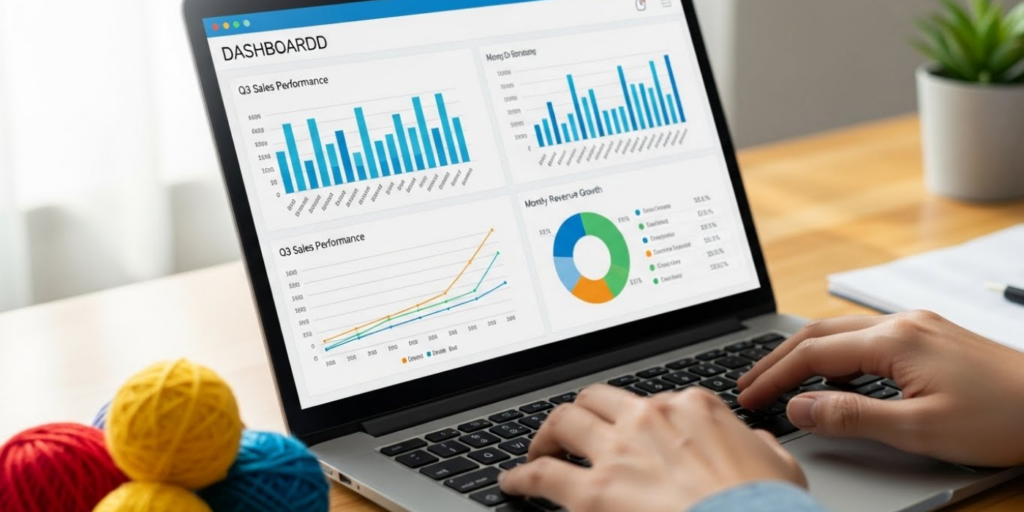
Before you can improve your sales, you need to know what to measure. Thankfully, most platforms (like Etsy, Shopify, or even Instagram) provide free built-in analytics—you just have to look in the right places.
Here are the four most important metrics for crochet sellers:
- Views & Impressions: How many people saw your listing or post? Low views often mean poor SEO, weak thumbnails, or inconsistent posting.
- Click-Through Rate (CTR): The percentage of people who clicked after seeing your product. A high CTR means your title, photo, or price is compelling.
- Conversion Rate: The percentage of visitors who actually bought. If you get lots of clicks but few sales, your pricing, description, or reviews might need tweaking.
- Traffic Sources: Where are your visitors coming from? Etsy search? Pinterest? Instagram? This tells you which platforms deserve more of your time.
For example, let’s say your “Crochet Pumpkin Amigurumi” gets 500 views per month but only 2 sales. That’s a 0.4% conversion rate—well below Etsy’s average of 1–3%. This signals a problem: maybe your photos don’t show scale, your description lacks care instructions, or your price is too high for the perceived value.
Action step: Log into your seller dashboard this week and identify one product with high views but low sales. Ask yourself: What’s stopping someone from clicking “Add to Cart”?
Tracking these basics gives you a clear starting point—no guesswork needed.
2. Optimize Your Product Listings Using Data
Your product listings are your digital storefront—and analytics can help you fine-tune every element for maximum impact.
Start with photos. On Etsy, sellers who use all 10 image slots typically see higher engagement. Use your analytics to see which photos get the most “saves” or time spent viewing. Do close-ups of stitch texture perform better than flat lays? Do lifestyle shots (e.g., a crochet bag worn by a model) drive more clicks than product-only images? Use that insight to guide future shoots.
Next, examine your titles and tags. Platforms like Etsy rank listings based on how well they match shopper searches. If your “Beginner Crochet Scarf Pattern” isn’t showing up for searches like “easy scarf crochet PDF,” you’re missing traffic. Use Etsy’s Search Analytics (in Seller Stats) to see which search terms are already bringing people to your shop. Then, weave those phrases naturally into your titles, tags, and descriptions.
For instance, if you notice “chunky yarn crochet blanket pattern” appears in your search terms—but you’ve been using “bulky yarn”—update your listing to match real customer language.
Pro tip: Tools like eRank or Marmalead (both offer free tiers) can show you high-traffic, low-competition keywords in the crochet niche. A small tweak like changing “crochet flower” to “crochet sunflower appliqué” could double your visibility.
Remember: Every word, image, and price point should be guided by what the data tells you—not just what you like.
3. Understand Your Audience: Who’s Buying (and Why)?
Analytics aren’t just about products—they’re about people. Who’s clicking on your “minimalist crochet coasters”? Are they mostly women aged 25–34 in the U.S.? Or are you getting unexpected interest from crafters in Germany searching for eco-friendly home decor?
Most platforms offer audience demographics:
- Etsy: Shows buyer location, device type (mobile vs. desktop), and even average order value.
- Instagram Insights: Reveals follower age, gender, and when they’re most active.
- Google Analytics (if you have a Shopify or WordPress site): Tracks behavior flow, bounce rate, and popular pages.
This intel is gold. For example, if 70% of your buyers are on mobile, make sure your product photos load quickly and your “Add to Cart” button is easy to tap. If most orders come from the U.S. in November, you’ve just confirmed that holiday shoppers are your biggest market—so plan seasonal collections accordingly.
Beyond demographics, pay attention to behavioral data. Which products do customers view together? If people who look at your “crochet plant hanger” also check out your “macramé wall art,” consider bundling them or creating a “Boho Home Bundle” listing.
Real-life win: One seller noticed her “baby bootie pattern” was often viewed alongside “gender-neutral nursery ideas.” She renamed it “Neutral Crochet Baby Booties – Perfect for Modern Nurseries” and saw a 40% sales jump in two months.
When you understand who your customer is and what they’re really looking for, you can speak directly to them—and that builds trust, clicks, and sales.
4. Test, Measure, and Refine: The Power of Small Experiments
You don’t need a marketing degree to run effective experiments. In fact, small, data-backed tweaks often outperform big overhauls.
Try A/B testing (also called split testing):
- Photo A vs. Photo B: Upload two different main images for the same listing over two weeks. See which gets more clicks.
- Price Test: Offer the same pattern at $4.99 one week and $5.99 the next. Does the higher price hurt sales—or signal higher quality?
- Title Variations: Test “Easy Crochet Hat Pattern” vs. “Beginner-Friendly Beanie Crochet PDF” to see which attracts more views.
Platforms like Etsy won’t let you run formal A/B tests, but you can track changes manually using a simple spreadsheet:
| Date | Change Made | Views | Favorites | Sales |
|---|---|---|---|---|
| June 1 | New main photo | 120 | 8 | 2 |
| June 8 | Updated title + tags | 180 | 15 | 5 |
Over time, patterns emerge. Maybe vibrant photos work better for amigurumi, while soft, neutral tones sell more home goods. Maybe your audience responds to urgency (“Limited stock!”) or to storytelling (“Inspired by my grandma’s stitches”).
Don’t guess—test. Even one successful tweak can compound into hundreds of extra sales per year.
Additionally, use seasonal analytics to plan ahead. Did your “witch hat crochet pattern” spike in September? Did custom pet portraits sell out every December? Use past data to stock, promote, and launch at the right time.
Analytics turns your business into a living, learning system—always improving, never stagnant.
5. Beyond Sales: Using Analytics to Build a Sustainable Creative Business

Finally, remember that analytics isn’t just about making more money today—it’s about building a resilient, joyful business for the long term.
For example, tracking which products have the highest profit margin (not just highest sales) can help you focus on what’s truly sustainable. A $20 amigurumi might sell well, but if it takes 5 hours to make, your hourly rate is low. Meanwhile, a $7 digital pattern that sells 50 times a month with zero extra work? That’s scalable.
Use data to:
- Identify your best-selling categories → make more of what people love
- Spot customer pain points (e.g., high cart abandonment) → add FAQs or shipping info
- Measure email or social campaign ROI → double down on what drives traffic
And don’t forget to track your own well-being. If analytics show you’re spending 10 hours a week on a platform that brings in 5% of your income, it might be time to shift focus. Your time is precious—data helps you protect it.
One crochet artist used her Shopify reports to realize 80% of her income came from just three PDF patterns. She stopped making custom orders, rebranded around digital products, and now works fewer hours with higher income and more creative freedom.
That’s the real power of analytics: it doesn’t just improve sales—it helps you build a business that aligns with your life.
Conclusion
Using analytics to improve your crochet sales isn’t about becoming a data scientist—it’s about listening to your customers through the numbers they leave behind. From optimizing product photos and titles to understanding buyer behavior and running simple experiments, every insight brings you closer to a thriving, sustainable creative business.
We’ve covered how to track key metrics, refine listings based on real search behavior, learn who your ideal customers are, test changes with confidence, and even use data to protect your time and energy. The goal isn’t perfection—it’s progress, one thoughtful tweak at a time.
So don’t let “analytics” intimidate you. Start small: check your Etsy stats today, review your top-performing post on Instagram, or simply ask, “What’s one thing my data is trying to tell me?”
Now we’d love to hear from you: Have you ever used shop analytics to make a change that boosted your sales? Or is there a metric you’ve always wanted to understand better? Share your experience or questions in the comments below—let’s learn and grow together! And if this guide helped you, please pass it on to a fellow maker who’s ready to stitch smarter, not harder. Happy selling! 🧶📊

Sophia Williams is a crochet enthusiast who found in yarn and hooks a creative way to express calm, patience, and love for handmade art. Focused on the crochet niche, she shares her experience, techniques, and inspiration with those who want to learn, relax, and create meaningful pieces stitch by stitch.