
Introduction
You’ve just started learning to crochet—maybe you watched a few YouTube tutorials, bought a cute hook-and-yarn kit, and dreamed of making cozy blankets or stylish scarves. But somewhere between your first chain and your fifth row, things went sideways. Your edges are wavy, your stitches look uneven, and you’re pretty sure you added (or lost) a stitch without meaning to. Sound familiar?
Don’t worry—you’re not alone. Almost every crocheter, from hobbyists to professionals, made these same beginner mistakes early on. Crochet is deceptively simple in concept but full of tiny details that make a big difference in the final result. The good news? Most common errors are easy to fix once you know what to look for.
In this article, we’ll walk you through the most frequent mistakes new crocheters make—and exactly how to correct them. From counting chains wrong to inconsistent tension and twisting your foundation chain, we’ll break down each issue with practical solutions you can apply right away. By the end, you’ll feel more confident, waste less yarn, and actually enjoy the process instead of feeling frustrated. Ready to turn those “oops” moments into “aha!” wins? Let’s get started.
1. Not Counting Stitches (or Counting Them Wrong)
One of the #1 reasons projects end up lopsided or misshapen? Losing or accidentally adding stitches—especially at the beginning or end of a row.
Beginners often forget that the turning chain (the chain you make at the start of a new row) may or may not count as a stitch, depending on the stitch type. For example:
- In single crochet (sc), the turning chain (usually 1 chain) does NOT count as a stitch. So you work your first sc into the very first stitch of the previous row.
- In double crochet (dc), the turning chain (usually 3 chains) often DOES count as the first stitch. So you skip the first stitch of the row and start your first dc in the second stitch.
Why this matters: If you treat the turning chain as a stitch when it’s not (or vice versa), you’ll gain or lose a stitch every row. Over time, your rectangle becomes a trapezoid!
How to fix it:
- Always check your pattern’s stitch guide—it should clarify whether the turning chain counts.
- Use stitch markers! Place a small safety pin or plastic ring in the first and last stitch of each row. This makes it easy to spot where to start and stop.
- Count your stitches at the end of every row until it becomes second nature. Even experienced crocheters do this on complex projects.
This simple habit alone will dramatically improve your consistency and shape accuracy.
2. Inconsistent Tension: Too Tight or Too Loose
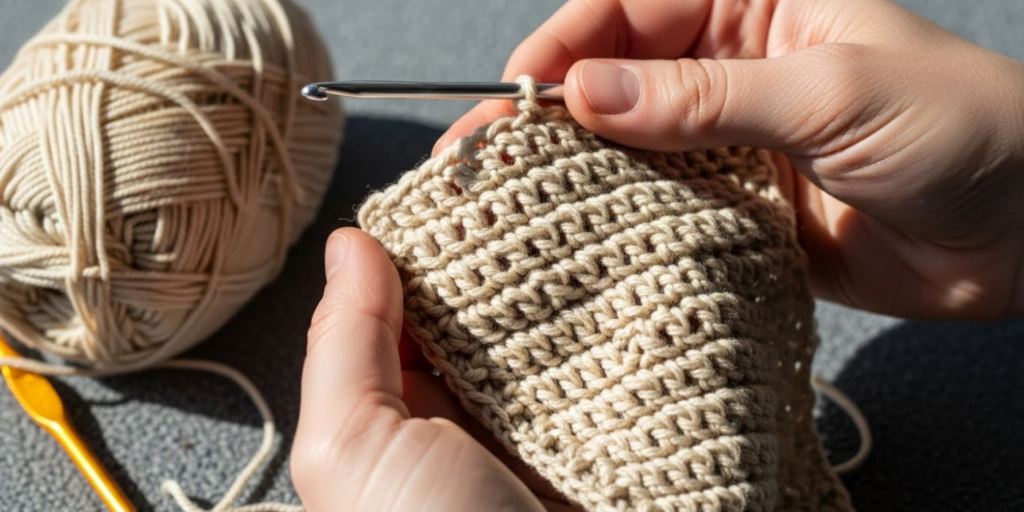
Ever notice that one side of your work looks neat while the other looks loose and sloppy? Or that your hook keeps snagging because the yarn is wound too tightly? That’s tension trouble—and it’s incredibly common among beginners.
Tension refers to how tightly or loosely you hold and pull the yarn as you work. Tight tension makes stitches stiff and hard to work into; loose tension creates gaps and floppy fabric. Both make your project look uneven.
Why it happens: New crocheters often grip the hook or yarn too firmly out of nervousness or over-focus. Others let the yarn dangle loosely because they haven’t learned to control it with their fingers yet.
The fix? Practice + awareness:
- Hold the yarn gently but steadily between your pinky and ring finger, letting it glide smoothly as you pull loops through.
- Don’t yank the yarn after completing a stitch. Let the hook do the work.
- Try the “pencil grip” vs. “knife grip” to see which feels more natural for relaxed movement.
- Work a small swatch (just 10–15 stitches) daily for a week. Focus only on keeping your stitches even—not speed or perfection.
Pro tip: If your hands cramp, you’re holding too tight. Shake them out and take breaks. Crochet should feel rhythmic, not stressful.
Over time, your hands will “learn” the right pressure, and your tension will even out naturally.
3. Crocheting Into the Wrong Part of the Stitch
It sounds simple: insert hook, yarn over, pull through. But where you insert your hook makes all the difference.
Many beginners accidentally work into the back bump, front loop only, or even the row below—especially when tired or distracted. This creates uneven texture, distorted shapes, or holes in your fabric.
Standard stitches (like sc, hdc, dc) are usually worked under both top loops of the stitch—unless the pattern says otherwise (e.g., “front loop only” for ribbing).
How to spot it: If your work looks bumpy, has unexpected ridges, or your edges are jagged, you might be hitting the wrong spot.
How to fix it:
- Look closely at the top of your row. You’ll see a “V” shape—that’s your stitch. Insert your hook under both legs of the V.
- Use good lighting and maybe a magnifier if you’re working with dark yarn.
- Practice on light-colored, medium-weight yarn (like worsted weight “4”)—it’s easier to see stitch structure.
- Slow down. Speed comes later. Right now, accuracy matters more.
Think of each stitch as a little doorway—you always want to go through the same “door” unless instructed otherwise.
4. Twisting the Foundation Chain
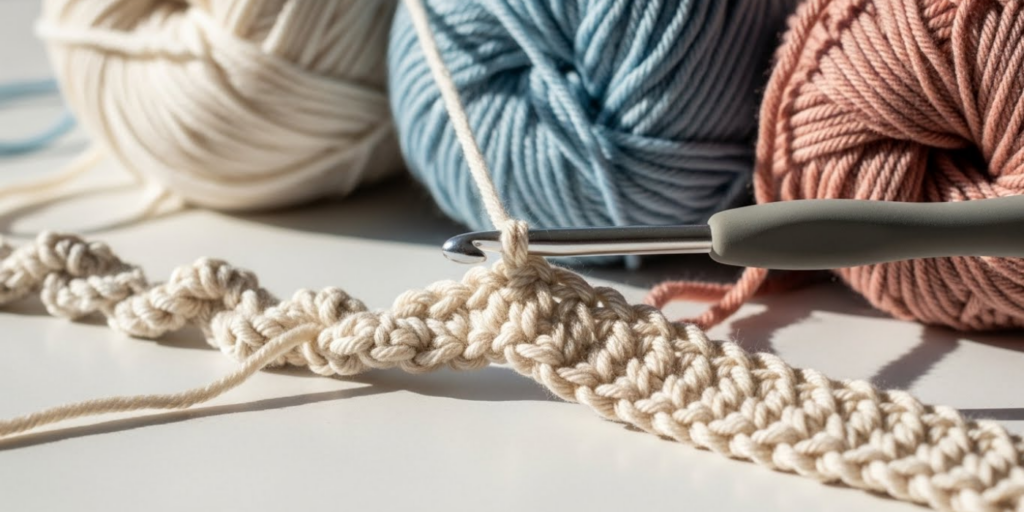
You start with a straight chain, but by Row 2, your work is twisted like a Möbius strip. What happened?
This happens when the foundation chain flips or rotates as you turn your work. Since chains have a front and back, twisting them means you’re suddenly working into the wrong side—creating a spiral instead of a flat piece.
Why it matters: A twisted foundation ruins scarves, blankets, and anything meant to lie flat. It’s also hard to fix once you’ve gone several rows.
How to prevent it:
- After making your foundation chain, lay it flat on the table.
- Look at the last chain you made—it should look like a smooth “V” on top and a bumpy back.
- Keep the “bumpy” side facing you as you work Row 1.
- When you finish Row 1 and turn to start Row 2, rotate the work toward you (like turning a page in a book), not away. This keeps the orientation consistent.
Quick check: Before starting Row 1, ensure all chains face the same direction—no twists, no flips. If you see a twist, undo and re-chain.
This tiny adjustment saves hours of frustration later!
5. Ignoring Gauge (Even on Simple Projects)
Many beginners skip gauge—the measure of how many stitches and rows fit into a 4-inch square—thinking it only matters for sweaters or fitted garments. But gauge affects every project, even dishcloths or blankets!
Why? Because everyone crochets differently. One person’s “medium” hook with “medium” yarn might produce a dense fabric; another’s might be airy and loose. If you ignore gauge, your finished item could end up much smaller or larger than intended—or use way more yarn than expected.
Example: A baby blanket pattern calling for 30” x 30” might come out 24” x 24” if your tension is too tight. That’s a big difference!
How to check gauge:
- Make a swatch at least 5” x 5” using the hook and yarn recommended.
- Lay it flat (don’t stretch it!).
- Use a ruler to count stitches and rows in 4”.
- Compare to the pattern’s gauge.
If you’re off:
- Too many stitches? Your tension is tight → go up a hook size.
- Too few stitches? Your tension is loose → go down a hook size.
Yes, it takes a little extra time—but it saves yarn, time, and disappointment in the long run. Treat every swatch as a mini-investment in your project’s success.
6. Not Starting with the Right Materials
It’s tempting to grab the cheapest yarn or a random hook from a craft store bin. But beginner-friendly materials make learning easier.
Common pitfalls:
- Using fuzzy, dark, or slippery yarn (like mohair or silk) — hard to see stitches.
- Choosing a tiny hook (like size B or C) with thin yarn — causes hand fatigue and frustration.
- Using cotton that doesn’t show stitch definition well.
What to use instead:
- Yarn: Medium-weight (worsted, #4) in a light, solid color (e.g., cream, light blue, or gray). Acrylic or wool blends are forgiving and affordable.
- Hook: Size I-9 (5.5 mm) or H-8 (5.0 mm)—large enough to see clearly, small enough to control.
- Extras: Stitch markers, a yarn needle for weaving ends, and sharp scissors.
Think of it like learning to drive: you wouldn’t start in a race car on a icy road. Give yourself the best possible conditions to succeed!
Embrace the Learning Curve—Mistakes Are Part of the Process
Here’s a gentle reminder: every crocheter has unraveled (“frogged”) a project. We’ve all had wonky scarves, holey blankets, and mystery extra stitches. Those “failures” aren’t wasted time—they’re how you build skill, patience, and intuition.
Instead of aiming for perfection, aim for progress. Celebrate that your tension is better than last week. Pat yourself on the back for catching a missed stitch early. And remember: even imperfect handmade items carry love and effort—something no store-bought item can replicate.
Conclusion
Crochet is a joyful, relaxing, and creative craft—but like any new skill, it comes with a learning curve. By understanding and correcting these common beginner mistakes—miscounting stitches, uneven tension, hook placement errors, twisted chains, ignoring gauge, and poor material choices—you’ll create cleaner, more professional-looking projects from the start.
The key isn’t avoiding errors entirely; it’s learning to spot and fix them quickly. With a little patience, the right tools, and consistent practice, you’ll develop muscle memory and confidence that make these issues fade into the background.
So grab your hook, choose a forgiving yarn, and try again. That blanket, hat, or gift you’re dreaming of is absolutely within reach.
We’d love to hear from you! What was your biggest “aha!” moment as a beginner crocheter? Or which mistake do you still catch yourself making? Share your story in the comments below—and if this guide helped you, pass it on to a fellow crafter who’s just starting their journey. Happy stitching!

Sophia Williams is a crochet enthusiast who found in yarn and hooks a creative way to express calm, patience, and love for handmade art. Focused on the crochet niche, she shares her experience, techniques, and inspiration with those who want to learn, relax, and create meaningful pieces stitch by stitch.